Put Your Phone Down and Fold Your Leaf: The Dinner Ritual America Desperately Needs
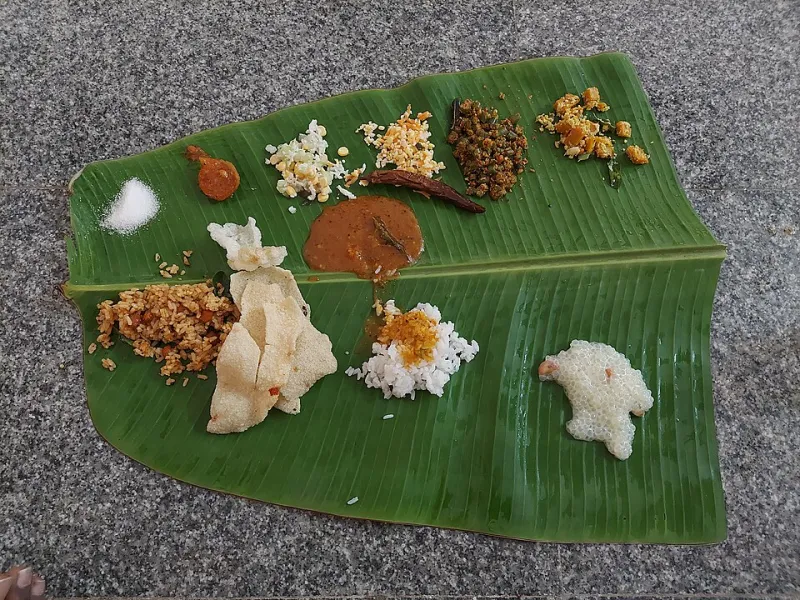
Photo: Codegeass123, CC BY-SA 4.0, via Wikimedia Commons
I'll Say It: We Eat Like We're Waiting for Something Better to Happen
Be honest. When did you last eat a meal without a screen within arm's reach? When did you last finish dinner and feel like something had actually occurred — not just refueled?
We've optimized eating into oblivion. Meal kits, drive-thrus, protein shakes in the car. The average American dinner now lasts about the length of a podcast segment and is remembered about as long.
Which is why I keep coming back to the banana leaf — a table setting so old it predates written etiquette and so satisfying it makes a $200 stoneware place setting feel emotionally bankrupt.
The Leaf Is Not a Plate. It's a Program.
In South Indian tradition, the banana leaf is laid with the narrow end pointing left (or the spine running horizontally, depending on the region — every family has a stance and will defend it). Then the food arrives in a precise choreography:
- Salt goes at the top left corner first. Always.
- Pickles, chutneys, and pachadis follow along the top edge.
- The center stage belongs to rice — a generous mound, the anchor of the meal.
- Curries, kootu, and poriyal circle the rice. Payasam, if you're lucky, arrives in a small cup or poured over the rice toward the end.
- Ghee is added early, because ghee is not optional and never has been.
You eat with your right hand, mixing as you go, working from the center outward. And here's the rule that gets everyone: when the meal is done, you fold the top of the leaf toward the bottom if you're a satisfied guest. Folding the other way signals you're done with the host's hospitality — traditionally, at funerals.
Get it wrong at your first banana leaf dinner and everyone will laugh with you, then correct you, then feed you more. That's the whole culture in one gesture.
Why It Works on Jaded American Diners
The leaf does three things we've forgotten how to do:
It slows you down. You cannot scroll a phone with hands that are busy mixing rice and sambar. The leaf demands both hands and full attention. It's the original screen-time blocker.
It's compostable and disposable. One dinner party, zero dishes, and the leaves go straight into the compost or garden. Your dishwasher gets the night off; the planet gets a small win.
It makes everyone equal. No one's plates match because no one has plates. The food is the only decoration, and it's spectacular against the glossy green.
Sourcing Leaves in the US (Yes, It's Doable)
Frozen banana leaves are your friend. Indian, Thai, Vietnamese, and Latin American grocery stores all carry them — the Latin markets sometimes label them "hojas de plátano." Asian markets in most mid-size cities stock them in the freezer case. Online retailers ship them frozen nationwide.
Thaw, then run each leaf briefly over a low flame or dip in hot water. This wilts it just enough to become pliable and releases the faint, green aroma that perfumes the whole meal.
No leaf? No tragedy. Parchment paper works as a runner-up, and a clean slate of any kind beats a stack of ceramic plates for ceremony. But do try the real thing at least once. The smell alone is worth it.
Hosting a Banana Leaf Dinner: The Bare Minimum
You need: rice, sambar or a hearty lentil dish, one dry vegetable stir-fry, one kootu (stew), a pickle, a chutney, appalam (papad), and payasam for dessert. That's it. That's the menu.
Tell guests ahead of time: hands, not forks. Show them the fold. Put phones in a basket by the door and don't apologize for it.
I've hosted a lot of dinner parties. The banana leaf ones are the ones people text me about weeks later. Not because the food was the best I've ever made — though it was — but because for ninety minutes, nobody at that table was anywhere else.
In 2024, that might be the most luxurious thing you can serve.