Crispy, Soft, or Somewhere In Between: What Your Dosa Order Reveals About Where You Come From
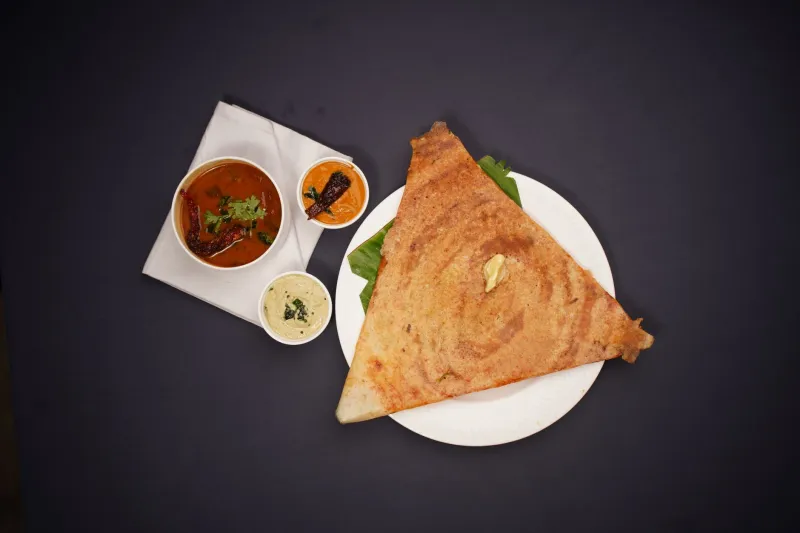
Order a dosa at a restaurant and watch what happens at the table next to you. Someone's going to pick up their first piece and immediately break it with a satisfying crack. Someone else is going to peel a soft, pillowy section away from the edge and fold it gently before dipping. And if there's a group with mixed South Indian backgrounds, there's a decent chance they'll spend at least three minutes discussing which version is actually superior before anyone takes a bite.
This is the dosa debate. It's real, it's passionate, and it's been playing out in South Indian households—and increasingly in American cities—for generations.
At its core, dosa is simple: a fermented batter of rice and urad dal, spread thin on a hot griddle. But within that simplicity lives an enormous range of textures, flavors, and regional identities. And as South Indian cuisine finds its footing in the American food scene, the question of what kind of dosa you prefer has started to carry a surprising amount of cultural weight.
The Tamil Nadu School: Thin, Lacy, and Aggressively Crispy
If you grew up in a Tamil household or spent any time eating at a traditional Tamil Nadu-style restaurant, you probably have strong opinions about dosa texture. Specifically, you probably believe a proper dosa should be thin enough to see light through at the edges, golden to the point of near-translucency, and crispy enough that it makes a sound when you tap it.
This style—sometimes called the paper dosa in its most extreme form—requires a batter with a higher rice-to-dal ratio, a well-seasoned iron griddle, and the kind of confident, fast-moving ladle work that takes real practice to develop. The batter is spread outward in a circular motion, getting thinner with each pass, and the result is almost more crepe than pancake.
The flavor is slightly tangy from fermentation, with a nuttiness from the dal and a crispiness that holds up even after you've dunked a corner in sambar. It's a texture-first experience, and Tamil dosa lovers will tell you that softness is, frankly, a failure of nerve.
Karnataka's Softer Stance
Cross into Karnataka and the conversation shifts. Bengaluru-style dosas tend to be thicker, slightly more spongy in the center, and less intensely fermented. The batter often includes a higher proportion of urad dal and sometimes a small amount of poha (flattened rice), which contributes a softer, more pillowy texture.
The Masala Dosa from Karnataka—arguably the version that most Americans have encountered first—typically has a crispy exterior but a soft, yielding interior, especially around the potato filling. It's a compromise of sorts, offering textural contrast rather than committing fully to either camp.
Karnataka home cooks we've spoken with often describe their dosa preference in terms of comfort—the soft center is where the flavor lives, they say, and all that crackling crispiness just gets in the way of tasting the batter itself.
"My mother always said a dosa should feel like a hug, not a cracker," laughed Priya, a Bengaluru native now living in the Bay Area who has been making dosas for her American friends every weekend for the past three years. "They always ask for it extra crispy now because that's what restaurants here serve. But at home, I make it the way I grew up eating it."
Andhra's Influence: Spice and Fermentation Front and Center
Andhra Pradesh and Telangana bring yet another dimension to the dosa conversation. In these regions, the batter itself often carries more heat—sometimes from the addition of green chili paste or fenugreek seeds that deepen the fermentation tang—and the dosa is frequently served with chutneys that are noticeably spicier than their Tamil or Karnataka counterparts.
The texture preferences in Andhra tend to run toward medium-crispy, but the defining characteristic is really the flavor intensity of the batter rather than the crunch factor. Fermentation is taken seriously here, with many households fermenting the batter for longer periods to develop a more pronounced sour note.
For Andhra immigrants in the US, the challenge is often finding the right combination of long-grain and short-grain rice to replicate that specific tang. "American rice just doesn't ferment the same way," said Ravi, a software engineer in Austin who grew up in Hyderabad. "I've tried every combination. I finally found a parboiled rice at a store in Houston that gets close. But it still doesn't taste exactly like home."
The Fermentation Question: Quick Batter vs. the Real Thing
Then there's the matter of fermentation itself—and this is where the debate gets particularly heated among American home cooks who've discovered dosa through food blogs and YouTube tutorials.
Authentic dosa batter requires time. The rice and dal are soaked separately, ground, mixed, and then left to ferment at room temperature for anywhere from 8 to 24 hours, depending on the climate. The fermentation develops lactic acid bacteria, which give the batter its characteristic tang, improve its nutritional profile, and create the tiny air bubbles that make a well-fermented dosa light rather than dense.
But fermenting batter in a Chicago apartment in February is a different proposition than fermenting it in Chennai in June. The cold slows fermentation dramatically, and many American home cooks—South Indian diaspora included—have turned to workarounds: adding a pinch of baking soda, using quick-ferment recipes with yogurt, or simply buying pre-made batter from Indian grocery stores.
Purists find this deeply troubling. "The fermentation is the whole point," insists Meenakshi, who runs a cooking class in New Jersey teaching traditional Tamil recipes to second-generation Indian Americans. "When you skip it, you're making a rice crepe. It's not a dosa. I say that with love."
But plenty of home cooks—and a growing number of American food lovers who've fallen for dosa at restaurants and want to make it at home—argue that a good quick-batter dosa is better than no dosa at all. And honestly, it's hard to disagree entirely.
American Palates Are Writing Their Own Chapter
What's fascinating about watching dosa culture take root in the US is that American diners are developing their own preferences without the regional baggage that shapes South Indian opinions. For someone in Portland or Nashville who encountered dosa for the first time at a local South Indian restaurant, there's no inherited loyalty to a particular style. They just know what they like.
And increasingly, what they like is crispy. Restaurant dosas in the US tend to lean toward the thin, lacy, heavily crisped version—partly because it photographs beautifully, partly because the texture contrast with soft fillings and wet chutneys appeals to American flavor sensibilities, and partly because crispy things are simply easy to love.
But as South Indian food becomes more familiar—as people start cooking it at home, exploring different regional styles, and seeking out restaurants that go beyond the standard menu—those preferences are getting more nuanced. People are asking for the neer dosa from Karnataka (a rice-only, delicate, almost translucent version), or the set dosa (thick, soft, spongy, served in a stack), or the uttapam (a thick pancake with toppings), and realizing that the dosa universe is a lot bigger than they thought.
So Who's Right?
Here's the honest answer: everyone. The Tamil Nadu crispy-dosa devotee is right that a perfectly executed paper dosa is one of the great pleasures of South Indian cuisine. The Karnataka home cook is right that there's something deeply satisfying about a soft, pillowy dosa that lets the batter's flavor speak for itself. The Andhra household is right that fermentation depth and spice complexity can transform the whole experience.
And the American home cook who made their first dosa from a quick-batter recipe on a Sunday morning and served it with store-bought coconut chutney? They're right too. They're at the beginning of a relationship with a dish that rewards curiosity and patience in equal measure.
At Srirangam Bhojnam, we think the best dosa is always the one that connects you to something—a memory, a region, a person who taught you how to spread the batter just so. The debate, ultimately, is just love by another name.