What a Mumbai Lunch Box Taught America About Eating Smarter
The Lunchbox That Runs on Time
Every morning in Mumbai, something remarkable happens. Tens of thousands of home-cooked meals get packed into stacked metal containers, handed off to a network of delivery workers called dabbawalas, and routed through trains, handcarts, and narrow alleyways to arrive — hot, intact, and on time — at office desks across the city. No apps. No GPS. Just a color-coded system that's been running since the 1890s and reportedly operates with a margin of error that would make a Swiss watchmaker jealous.
Harvard Business School has studied it. The BBC has filmed it. And now, quietly, American meal-prep culture is starting to catch up to what Indian home cooks figured out two centuries ago: that eating well during the workweek is less about willpower and more about systems.
What's Actually Inside the Box
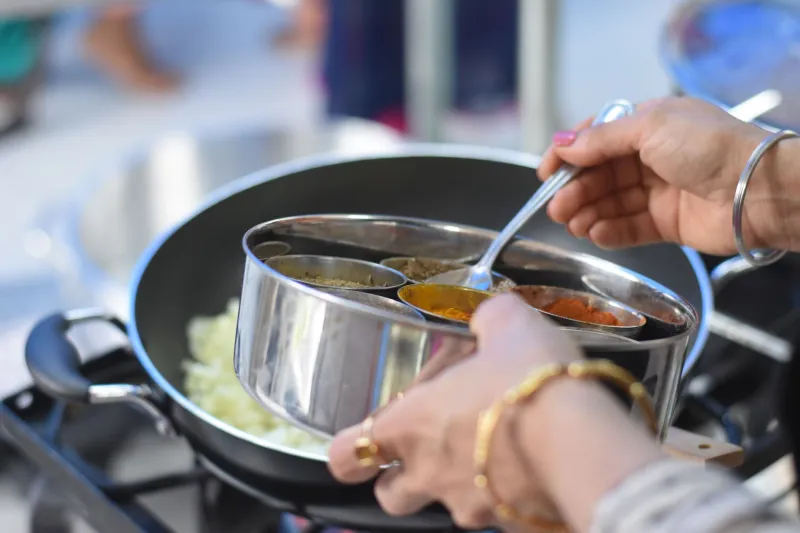
The tiffin — the word itself comes from British colonial slang for a light meal — is typically a set of stacked steel containers, each holding a different component of a balanced meal. Rice or roti in one tier. A lentil dal or sambar in another. A dry vegetable preparation, maybe a yogurt, sometimes a small sweet. Every component plays a role. Nothing is redundant. The whole thing is designed to travel well, reheat easily, and keep you full without making you sluggish through an afternoon of meetings.
South Indian home cooking, in particular, maps onto this format almost perfectly. A standard South Indian lunch — the kind that's been packed into tiffin boxes in Tamil Nadu, Andhra Pradesh, Karnataka, and Kerala for generations — already comes pre-divided by texture, temperature, and function. You've got your starchy base (rice, almost always), your protein-rich liquid component (sambar or rasam), your fiber-heavy dry vegetable side (a kootu or poriyal), and your probiotic cooling element (curd). That's four food groups in four compartments, assembled without anyone ever consulting a nutrition label.
Why American Meal Prep Got It Backwards
The modern American meal-prep trend, for all its good intentions, tends to do one thing the tiffin system never does: it collapses everything into a single container. Grilled chicken on top of rice on top of broccoli, all mixed together, all tasting the same by Wednesday. It's efficient, sure. But it's also a little depressing, and it's partly why so many people abandon their Sunday prep sessions by mid-month.
The tiffin philosophy is different. Separation is the whole point. When each component stays distinct, it retains its own flavor, texture, and integrity. The sambar doesn't make the rice soggy until you're ready to eat. The yogurt stays cool and tangy. The vegetable side keeps its bite. You're not reheating a monolith — you're reassembling a meal, which feels more like cooking and less like eating leftovers.
That psychological distinction turns out to matter more than most people expect. There's a reason South Indian families have been doing this for generations without ever burning out on the format.
Portion Logic Built Into the Design
One thing wellness coaches and dietitians have started pointing out is that the tiffin box does something that calorie-counting apps try and mostly fail to do: it builds portion awareness directly into the container. Each tier is a fixed size. You're not eyeballing a serving of dal into a Tupperware vat. The box tells you how much is reasonable.
South Indian cooking reinforces this naturally. Rice is present but not dominant. The dal or sambar provides satiety without heaviness. The vegetable side — often something like beans stir-fried with mustard seeds and coconut, or a spinach preparation with tamarind — adds volume and fiber without extra calories. The yogurt rounds everything out and aids digestion. It's a structure that nutritionists would approve of, and it didn't require a single food pyramid to design.
Bringing It to an American Kitchen
You don't need to live in Mumbai or have a dabbawala on your block to start thinking like a tiffin packer. The approach translates surprisingly well to a Sunday prep session in a Chicago or Austin kitchen.
Start by thinking in components rather than recipes. Cook a pot of rice. Make a batch of sambar — the kind that holds up over several days and actually gets better as it sits. Prep one or two dry vegetable sides that travel well, like a simple green bean poriyal or a carrot stir-fry with curry leaves and coconut. Set aside some plain yogurt. That's your week.
Invest in actual tiffin-style containers if you can find them — stacked steel lunch boxes are widely available online and at Indian grocery stores, and they're genuinely more practical than the single-compartment plastic containers most people use. They stack neatly, they don't leak, and they signal to your brain that lunch is something worth looking forward to.
The System Is the Point
What the dabbawalas understood — and what South Indian home cooks have practiced for generations — is that good daily eating isn't about eating something extraordinary every day. It's about having a reliable, satisfying system that you can execute without thinking too hard on a Tuesday morning.
The tiffin box isn't glamorous. It doesn't photograph particularly well for Instagram. But it works, day after day, decade after decade, in one of the most densely populated cities on earth. That's a track record that a lot of meal-prep trends can't come close to matching.
At Srirangam Bhojnam, the food we celebrate is exactly this kind of cooking — practical, nourishing, deeply flavorful, and built around rhythms that have stood the test of time. The tiffin box just happens to be one of the most elegant expressions of that philosophy ever invented. And honestly, it's about time more American kitchens took notice.