Two Cuisines, One Country: The Geographic Split That Makes South Indian Food Unlike Anything Else on the Subcontinent

Photo by Photo by Vivekarasan M on Unsplash on Unsplash
Let's say you've got two Indian coworkers—one from Delhi, one from Chennai. You invite them both to your place for dinner and ask each of them to cook. What shows up on your table will be so different that you might genuinely wonder if they grew up in the same country. One brings a rich lamb curry, thick with cream and warming spices. The other arrives with a container of sambar, a stack of idlis, and a coconut chutney so fresh it almost tastes like the ocean.
Same country. Completely different food universe.
This isn't a matter of preference or regional pride—it's the result of thousands of years of geography, climate, religion, and trade doing their quiet work on two very different landscapes. And if you're eating South Indian food for the first time, or wondering why it feels so unlike the Indian food you've tried before, the answer starts with a map.
The Landscape Decides the Lunch
North India is largely landlocked, defined by the vast Indo-Gangetic Plain. Wheat grows abundantly there. The winters are cold and dry. The cuisine reflects all of this: flatbreads like roti and paratha anchor every meal, dairy is used generously (think paneer, ghee, cream-based gravies), and the spice profile leans toward warming aromatics—cumin, cardamom, cloves, dried chili.
South India is something else entirely. It's a peninsula, wrapped on three sides by coastline and drenched in monsoon rains that make the land intensely fertile. Rice grows in paddy fields that stretch to the horizon. Coconut palms line every road. The Western Ghats—a mountain range running parallel to the coast—create a humid, tropical microclimate that's perfect for growing black pepper, cardamom, curry leaves, tamarind, and dozens of other ingredients that simply don't thrive up north.
The result? A cuisine that tastes lighter, brighter, and more vegetal—built around fermented rice batters, fresh coconut, and sour-tangy tamarind rather than cream and slow-cooked meat.
The Coconut Is Not Optional
If there's one ingredient that separates South Indian cooking from virtually everything else in the Indian culinary canon, it's coconut. And not just as a garnish—coconut in South Indian cooking is structural. It's foundational.
Fresh grated coconut goes into chutneys. Coconut milk thickens curries in Kerala. Coconut oil is the cooking fat of choice along the coast. Coconut water gets used in certain rice preparations. In Tamil Nadu, you'll find coconut in dishes you wouldn't expect—stirred into dry vegetable preparations called poriyal, blended into spice pastes, or scattered over a bowl of steaming sambar.
This isn't an accident. Coconut palms grow everywhere across South India's coastal belt, and for centuries, communities built their cooking around what was locally abundant. Why import expensive dairy fat when coconut oil is literally falling off the trees?
For Americans who've grown up eating North Indian restaurant food—the tikka masalas and butter chickens that became the face of Indian cuisine in the US—this coconut-forward profile can be genuinely surprising. It's lighter on the palate. It's less heavy after a meal. And it carries a completely different kind of richness.
Rice as a Way of Life
In North India, a meal without bread feels incomplete. In South India, a meal without rice is simply not a meal.
But it goes beyond just eating steamed rice with curry. South Indian cooks have done extraordinary things with rice. They ferment it overnight to make dosa and idli batters. They press it into flat cakes, steam it in banana leaves, puff it, flatten it, and grind it into flour. The sheer diversity of rice-based preparations across Tamil Nadu, Karnataka, Andhra Pradesh, and Kerala would take a lifetime to fully explore.
This rice obsession also explains why South Indian cuisine is so naturally vegetarian-friendly. When rice and lentils form your nutritional backbone, and when your local markets overflow with fresh vegetables and coconut, meat becomes more of an accent than a centerpiece. Many traditional South Indian households—particularly those with Brahmin or Jain influences—have been vegetarian for generations, not as a modern lifestyle choice but as a deeply embedded cultural practice.
That said, the coastal communities of Kerala, Tamil Nadu, and Andhra Pradesh have rich seafood traditions. Fish curries cooked in coconut milk, tamarind-spiced prawn preparations, and crispy fried fish served with rice and rasam are as much a part of the South Indian table as any lentil dish. It's a different relationship with protein—fresh, local, and tied to the geography of the coast.
The Spice Logic Is Different
Both North and South Indian cuisines are spiced, but the logic behind the spicing is completely different.
North Indian spicing tends to build complexity through layering—onions caramelized low and slow, whole spices bloomed in ghee, cream added to round out the heat. The result is deep, rounded, and intensely aromatic.
South Indian spicing is faster and more direct. Mustard seeds popped in hot oil. Curry leaves thrown in and allowed to crackle. Dried red chilies added whole. This technique—called tadka or tempering—happens at the beginning of a dish and again, often, at the end. It's a flash of flavor rather than a slow build. The spices are sharper, more citrusy, and more aromatic in a green, herbal way.
Tamarind does a lot of heavy lifting in South Indian cooking that cream and tomato do in the North. It provides acidity, depth, and a slight sweetness that anchors dishes like rasam and sambar. It's a flavor profile that feels almost Southeast Asian to many American palates—which makes sense, given that South India's ancient trade routes ran straight through what is now Thailand, Malaysia, and Indonesia.
Why This Matters at Your Next Meal
For most Americans, Indian food has been filtered through a very specific lens: the North Indian restaurant menu. Naan, tikka masala, saag paneer, biryani. These are great dishes. But they represent one slice of a wildly diverse culinary tradition.
South Indian food—the food we celebrate at Srirangam Bhojnam—is the other half of that story. It's the half that's lighter on cream but heavier on fermentation. The half that uses coconut where others use butter, and tamarind where others use tomato. The half that turns a humble lentil stew into something so nuanced and personal that every family makes it differently.
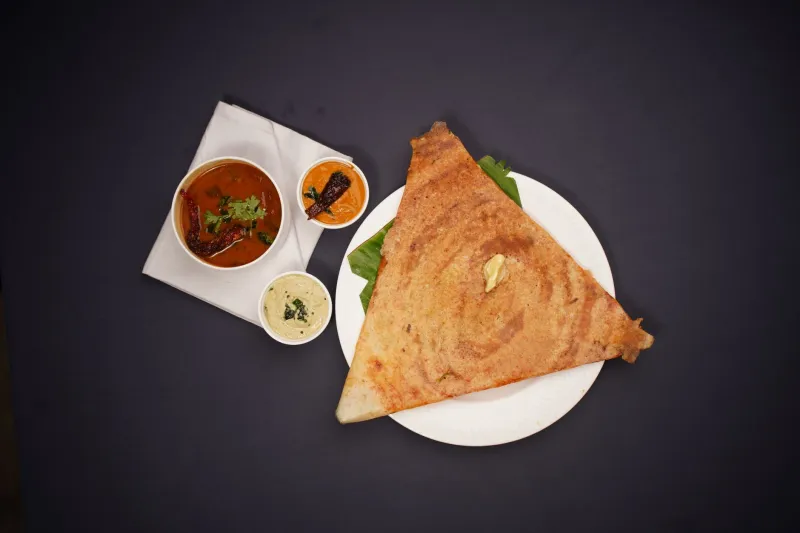
If you've been eating Indian food your whole life and never tried a properly made dosa with sambar and coconut chutney, you haven't actually seen the whole picture. And once you do, it's hard to go back to thinking of Indian cuisine as a single thing.
It never was.