Soft, Steamed, and Suddenly Everywhere: The Quiet American Rise of Idli

Photo by Photo by Shreyak Singh on Unsplash on Unsplash
There's a certain irony to the way food trends work in America. A dish can carry centuries of history, nourish hundreds of millions of people, and still spend decades being overlooked — right up until the moment a wellness influencer or a Michelin-curious chef discovers it and suddenly it's everywhere. That's more or less the story of idli right now.
If you've never had one, here's the short version: idli is a small, round, steamed cake made from a fermented batter of rice and black lentils (urad dal). It's soft, slightly sour, almost cloud-like in texture. It doesn't look like much. But it's been a cornerstone of South Indian breakfast culture for at least 2,000 years — some food historians trace early references back even further — and it's arguably one of the most nutritionally complete morning foods on the planet.
So why is it only now getting its American moment?
The Wellness Angle That Changed Everything
Ask anyone who's recently discovered idli in the US, and a pattern emerges. They weren't necessarily looking for South Indian food. They were looking for something high-protein, low-calorie, and easy on the gut — and idli kept coming up.
The numbers make a compelling case. A standard idli (roughly 40 grams) clocks in at around 39 calories, delivers about 2 grams of protein, and is virtually fat-free. The fermentation process — which typically takes 8 to 12 hours — breaks down phytic acid in the lentils, making the nutrients significantly more bioavailable than they'd be in an unfermented form. The result is a food that's not just light but genuinely easy to digest, which matters a lot to the growing American population dealing with IBS, gluten sensitivity, or just general digestive fatigue from heavily processed diets.
Registered dietitian Priya Anand, who runs a nutrition consulting practice in the Bay Area and works with a largely South Asian-American clientele, says she's been recommending idli for years but has noticed a real shift recently. "My non-South Asian clients are coming to me already knowing what idli is," she told us. "That didn't happen five years ago. Now they're asking me how to optimize the fermentation, what to pair it with for macros — it's a completely different conversation."
From Ethnic Aisle to Center Stage
Restaurant owners are noticing the shift too. At Srirangam Bhojnam, we've seen firsthand how customer questions about idli have evolved — from "what is this?" to "can I get a half-dozen to go?" The dish that once required a gentle explanation is increasingly something guests arrive already excited about.
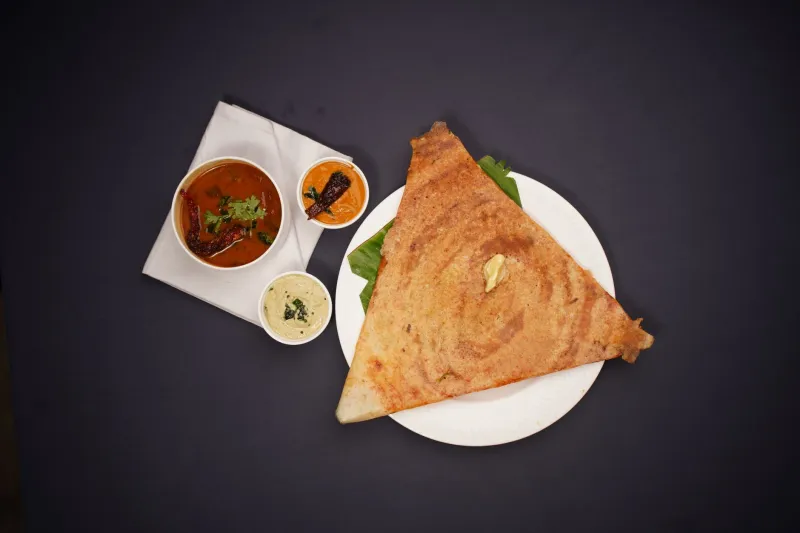
Similar stories are playing out at South Indian restaurants across the country. In cities like Houston, Chicago, and the New York metro area — which have long-established South Indian communities — restaurants that once catered almost exclusively to diaspora diners are reporting a broader, more diverse customer base specifically seeking out idli and its accompaniments: sambar (a lentil-based vegetable stew) and the various chutneys that make the whole experience sing.
The food delivery boom has accelerated this shift considerably. When someone can order a plate of idli on DoorDash without having to navigate an unfamiliar menu in an unfamiliar restaurant, the barrier to trying something new drops significantly. Curiosity converts to habit a lot faster.
The Fermentation Factor
Here's where things get genuinely interesting for food culture in America: idli isn't just riding the wellness wave. It's also benefiting from a broader American fascination with fermentation.
Kombucha, kimchi, sourdough, kefir — the last decade has seen fermented foods move from health food store novelties to mainstream grocery staples. Americans have developed a real appetite (pun intended) for understanding why fermentation matters, not just that it does. And idli fits neatly into that conversation. The fermentation process that gives idli its characteristic slight tang is the same process that makes it so digestible, so nutrient-dense, so different from a plain rice cake or a piece of toast.
Food writer and fermentation enthusiast Marcus Webb, based in Portland, Oregon, recently wrote about his idli deep-dive on his popular Substack newsletter. "I'd done sourdough, I'd done miso, I'd done my own kimchi," he wrote. "Idli batter felt like the logical next step — and honestly, the results were more immediately satisfying than almost anything else I'd fermented. You make the batter, you wait, you steam it, and twenty minutes later you're eating something that feels ancient and alive and completely unlike anything else in your breakfast rotation."
Trying It at Home: What You Need to Know
For Americans curious about making idli at home, the good news is that the ingredient list is genuinely short. You need idli rice (a parboiled short-grain variety available at most Indian grocery stores and increasingly at larger Asian supermarkets), urad dal, water, and salt. That's it.
The process, though, takes patience — and a few trial runs before you nail the fermentation.
The ratio matters. Most traditional recipes use a 3:1 ratio of idli rice to urad dal. Some cooks add a small amount of poha (flattened rice) or fenugreek seeds to help with fermentation and texture.
Grinding is everything. The batter needs to be smooth but aerated. A wet grinder (a countertop appliance common in South Indian households) produces the best results, but a high-powered blender works reasonably well. The goal is a batter that's light and slightly fluffy, not dense.
Temperature is your friend — or your enemy. Fermentation requires warmth. In South India's climate, leaving batter on the counter overnight is usually sufficient. In most American homes, especially in winter, you may need to put the batter in a turned-off oven with just the light on, or use the "proof" setting if your oven has one. Aim for around 75–80°F.
Common mistake: over-fermenting. If your batter sits too long or gets too warm, it'll turn overly sour and may not hold its shape when steamed. Check it after 8 hours. It should have roughly doubled in volume and smell pleasantly tangy — not sharp or alcoholic.
You need an idli mold. These are inexpensive (usually under $15 on Amazon) and worth having. They're tiered steel plates with small round indentations that stack inside a pot with a lid. Steam does the rest.
Why This Matters Beyond the Trend Cycle
Food trends come and go. Acai bowls had their moment. Cauliflower pizza crust had its moment. The difference with idli is that it isn't a novelty — it's a genuinely ancient, genuinely nutritious food with an enormous culinary tradition behind it. The chutneys alone (coconut, tomato, peanut, mint) represent a whole world of flavor that most Americans have barely touched.
At Srirangam Bhojnam, we've always believed that South Indian food deserves to be understood on its own terms — not as a curiosity, not as a health hack, but as a rich, layered cuisine with thousands of years of wisdom baked into its simplest dishes. Idli is a perfect entry point into that world. Once you've had a properly made idli — soft, warm, served with a bowl of fragrant sambar and a smear of coconut chutney — it's hard to think of it as anything other than exactly what it is: one of the great breakfast foods of the world, finally getting the recognition it's always deserved.