Cooking as an Offering: How Temple Prasad Philosophy Is Quietly Transforming South Indian Kitchens Across America
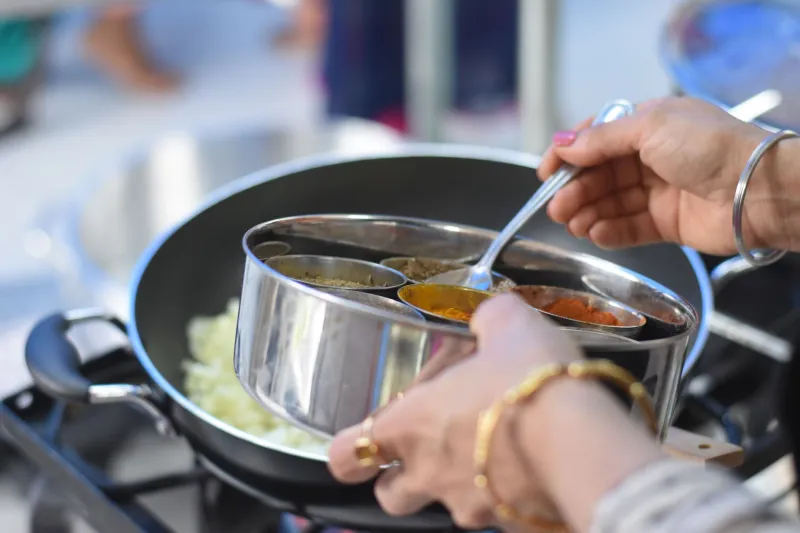
There's a moment that Priya Venkataraman, a home cook and mother of two in Fremont, California, describes almost every Sunday morning. She's standing at her stove before anyone else in the house is awake, stirring a pot of pongal — the soft, ghee-laced rice and lentil dish that's been a temple staple across South India for centuries. She's not following a recipe from her phone. She's going by memory, by smell, by something she says she can't fully explain.
"My grandmother used to say that when you cook for the temple, you cook without thinking about yourself at all," Priya says. "I'm not trying to impress anyone on Sunday mornings. I'm just trying to make something that feels right."
What Priya is describing has a name, even if she doesn't always use it: prasad. And it's showing up — quietly, without fanfare — in South Indian-American homes and restaurants across the country.
What Prasad Actually Means (Beyond the Banana Leaf)
Most people who've visited a Hindu temple in the US have encountered prasad in its most visible form: a small sweet pressed into your palm as you leave, or a spoonful of something warm ladled into a cup after a ceremony. It's easy to read it as a token gesture, a religious formality.
But prasad is a much bigger idea than that. The word itself comes from Sanskrit, loosely meaning "grace" or "divine favor." Food prepared as prasad is understood to be cooked in a state of devotion — with clean hands, a focused mind, and no expectation of recognition. The cook is not the point. The offering is.
In the great temple towns of South India — Srirangam, Tirupati, Madurai — this philosophy has been running institutional kitchens for over a thousand years. The Srirangam temple complex, one of the largest in the world, has fed pilgrims daily across generations, operating on the principle that feeding someone is an act of worship in itself. The food isn't fancy. It doesn't need to be. The intention is the ingredient.
From Temple Kitchens to American Zip Codes
When South Indian families began settling in the US in larger numbers through the 1990s and 2000s, they brought this philosophy with them — sometimes consciously, sometimes just embedded in the way they were raised. What's interesting now is that a younger generation, many of them born or raised in America, is actively choosing to bring it back.
Karthik Subramaniam, a chef who runs a small South Indian catering operation out of the Atlanta area, grew up watching his mother cook for temple events in Chennai. He moved to the US for graduate school and spent years working in corporate kitchens before eventually going out on his own. He says the turning point came when he stopped trying to make South Indian food look impressive and started cooking the way his mother did.
"In a restaurant, you're always thinking about the plate, the presentation, what the customer will say," he explains. "My mother never thought about any of that when she was cooking for the temple. She just cooked. And the food was always better."
Karthik now deliberately structures his catering service around what he calls "the prasad approach" — no elaborate garnishes, simple serving vessels, dishes that prioritize nourishment over novelty. His most popular offering? A full South Indian meal served on banana leaves, with rice, sambar, rasam, two vegetable sides, and payasam for dessert. Nothing revolutionary. Just done right, with care.
The Ego Problem in Modern Cooking Culture
Here's something worth sitting with: American food culture, especially in the social media era, has become extraordinarily ego-driven. Cooking is content. Plating is performance. The home cook photographs before they eat, the restaurant designs for the 'gram before it designs for flavor.
Prasad culture is almost the exact opposite of this. There's no credit to be taken. No audience to perform for. The act of cooking is private, internal, oriented entirely toward the person being fed — or, in the temple context, toward something larger than any individual person at all.
For South Indian-American families navigating a culture that constantly asks them to optimize and perform, this philosophy offers something genuinely countercultural.
Deepa Krishnamurthy, who hosts a monthly South Indian supper club in her Chicago home, puts it this way: "I started inviting people over because I was lonely after moving here. But somewhere along the way, I realized I wasn't cooking to show off. I was cooking because feeding people felt like the most honest thing I could do." She now begins every supper club evening with a small prayer — not because all her guests are Hindu, but because, she says, "it reminds me why I'm doing this."
What This Looks Like on a Practical Level
For families and cooks who want to bring prasad principles into their own kitchens, it doesn't require a temple or a religious framework. It's more about intention than ritual. A few things that show up consistently across the South Indian-American cooks and chefs we spoke with:
Cook without distraction. Many describe stepping away from podcasts and playlists when preparing food they consider important. The act of cooking gets full attention.
Make more than you need. Prasad is always abundant. There's no rationing. If you're making rice, make extra. If you're making sambar, make a full pot. The assumption is that there will always be someone else to feed.
Don't chase novelty. The dishes associated with prasad are almost always traditional — pongal, pulihora (tamarind rice), chakkara pongal (sweet pongal), coconut rice. Tried, tested, deeply familiar. The point isn't to innovate. It's to get it right.
Serve without ceremony. No elaborate plating. No waiting for compliments. You put the food out and you feed people.
Why This Resonates Right Now
It's probably not a coincidence that prasad philosophy is gaining traction at a moment when a lot of Americans — South Indian heritage or not — are exhausted by the performance of modern eating. There's a growing appetite (pun very much intended) for food that feels honest. Food that isn't trying to be anything other than what it is.
Restaurants like Srirangam Bhojnam have built their entire identity around exactly this idea: that the most authentic South Indian food isn't the most complicated or the most photogenic. It's the food that was made to be shared, to nourish, to honor the person sitting across from you.
That's not a new idea. It's actually a very, very old one. And it turns out it travels pretty well.
Priya is still stirring her pongal on Sunday mornings. Her kids are starting to ask if they can help. She says she tells them the same thing her grandmother told her: wash your hands, pay attention, and don't cook for yourself.
"Cook for whoever's going to eat it," she says. "That's the whole thing, really."